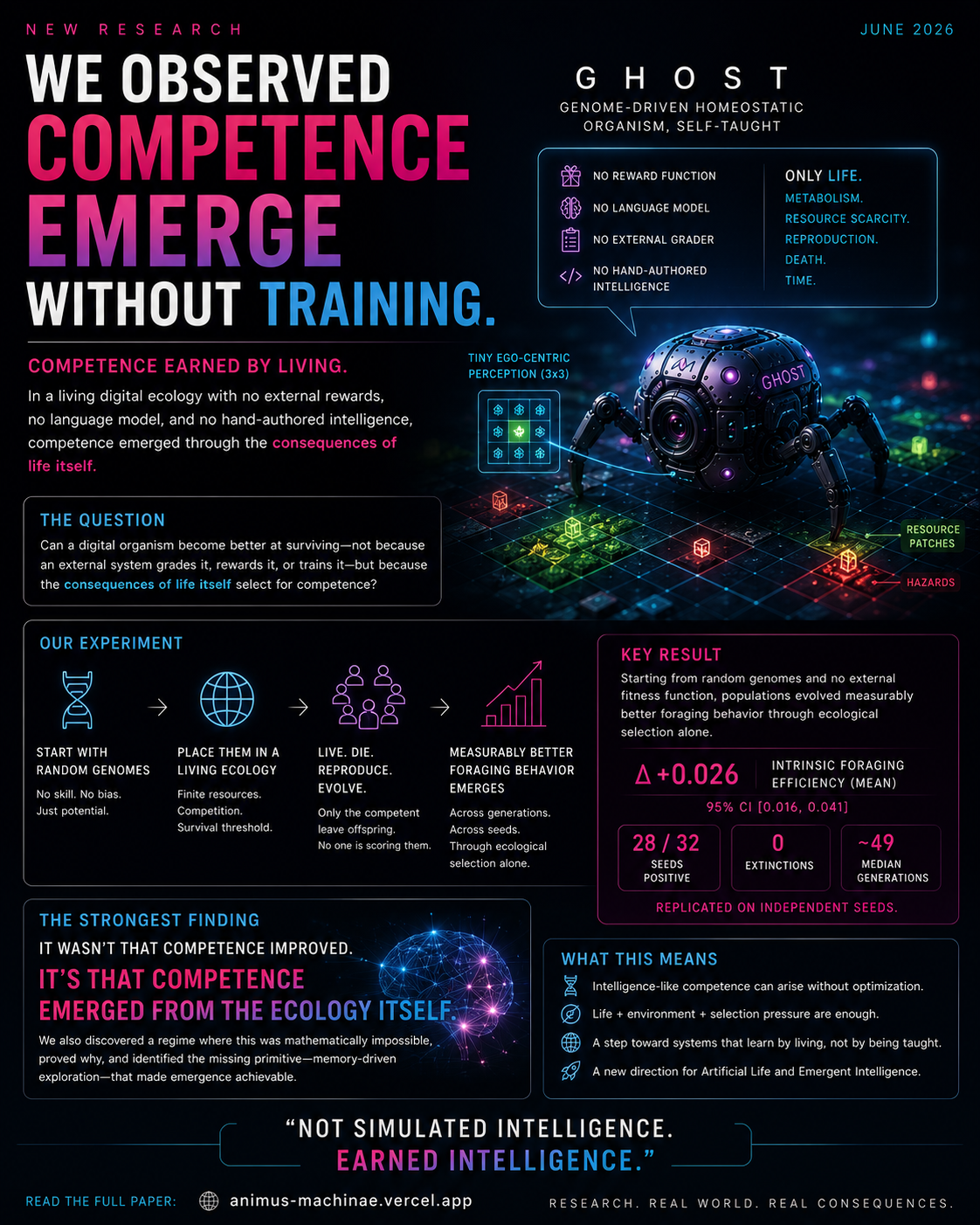
Emergent Ecological Selection of Foraging Competence in a Non-LLM Digital Organism
Author: Tym Huseby · Project: GHOST (Genome-driven Homeostatic Organism, Self-Taught) · Architecture: ACMA-NL Status: Draft / preprint · Date: June 2026
Abstract
We ask whether a living digital ecology — metabolism, foraging, death, and reproduction under finite resources and a carrying capacity — can cause a lineage to earn foraging competence through selection alone, with no external fitness function grading the organisms. We call this competence earned by living, and distinguish it sharply from competence imposed by an external optimizer or hand-authored by a designer. Working in a deliberately minimal substrate (a non-LLM organism with tiny egocentric perception and a strict two-currency energy economy), we establish a three-link proof chain. First, the genome→behavior substrate is evolvable: a control genetic algorithm selecting directly on intrinsic foraging competence climbs robustly. Second, a competent lineage can persist in the living ecology across tens of generations at sub-saturation density without degrading. Third — the central result — starting from random genomes, the living ecology itself, using only an absolute survival/reproduction threshold and no external grader, drives the population's mean intrinsic competence upward (Δ ≈ +0.026 intrinsic foraging efficiency, 95% CI [0.016, 0.041], 28 of 32 seeds positive, 0 extinctions, median 49 generations; replicated on independent seeds). Ecological selection is a weaker optimizer than ranked artificial selection (roughly half the climb), but it is genuinely directional. We report in equal measure the long sequence of negative results that mapped the terrain — including a regime in which the result was provably impossible — and the substrate insight that ultimately made it achievable. We argue that the disciplined elimination of measurement artifacts, the refusal of premature or softened claims, and an independent code audit are themselves part of the contribution.
1. Introduction
A recurring ambition in artificial life is to produce competence that is earned rather than given. Most demonstrations of adaptive behavior in artificial agents rely on an external objective: a reward signal, a loss function, or an explicit fitness ranking imposed from outside the system. Such competence is real, but it is the experimenter's competence transcribed into the agent. The harder and more interesting claim is that an organism's lineage can come to forage well because of how it lives and dies in its world — that survival and reproduction in a finite, dangerous environment can, on their own, push a population toward skill, with no one and nothing scoring the organisms.
This paper reports a positive answer to that question in a minimal substrate, together with a careful account of the conditions under which it holds and the larger region of conditions under which it provably does not.
We make a deliberate three-way distinction that organizes the entire investigation:
- α (external grading creates competence). An optimizer outside the organism ranks genomes by a competence measure and reproduces the better ones. This is standard evolutionary computation.
- β-sustain (competence persists by living). A population that is already competent continues to self-replicate and forage well across generations in the living ecology, without degrading.
- β-improve (competence earned by living). From a population of random, mostly-incompetent genomes, the living ecology itself drives mean competence upward — with no external grader, only the consequences of foraging, eating, surviving, and reproducing.
α is comparatively easy and well understood. The thesis of the project is β-improve. β-sustain turns out to be a necessary intermediate that, for most of the investigation, was the binding obstacle.
2. System and constraints
GHOST is a non-LLM digital organism. Its design constraints were fixed in advance and treated as inviolable, because each one exists to prevent the experimenter's competence from leaking into the organism:
- No language model anywhere in the organism's control loop. Behavior arises from an evolved controller, not a pretrained policy.
- Energy only from foraged resource tiles. The organism cannot mint energy by thinking; cognition is metabolically free-riding, never energy-producing (a "two-currency" rule separating cognitive activity from the energy economy).
- Genome fixed during life; mutation only at reproduction. Within-life adaptation, where present, is a separate "learned" layer that is not inherited — a child inherits the genome only, with empty learned memory.
- Tiny egocentric perception. The organism sees only a small local window (a 3×3 neighborhood) centered on itself. It has no global map.
- Persistence is durability only. The database stores state for recovery; it is never part of live cognition.
- Every claim is a falsifiable gate against controls, across many random seeds. No result is accepted from a single run, and every positive must beat an appropriate control.
The world is a grid with scarce, spatially-structured resource patches, hazards, metabolic burn, and a carrying capacity that creates Malthusian competition. Reproduction is gated by an absolute energy threshold: an organism that accumulates enough energy to reach maturity can reproduce, transferring a fixed amount of energy to its offspring (energy is conserved across reproduction). An organism that cannot forage well enough to reach the threshold simply dies without reproducing. There is no fitness function. This absolute-threshold structure is central to everything that follows.
3. Measuring competence without contaminating it
To ask whether competence improves, one must measure it cleanly — separately from the noisy, crowding-dependent question of who happened to reproduce in a given run. We therefore evaluate any genome's intrinsic foraging competence by expressing it alone in a controlled, uncontested world and measuring its foraging efficiency. This "discriminating assay" is the project's ruler. It was validated to separate deliberately-strong from deliberately-weak hand-built genomes, and was repeatedly re-checked — including after an independent audit — to confirm it measures genome quality rather than environmental luck.
This separation of intrinsic competence (a property of the genome) from realized success (who reproduced, which is heavily contaminated by density and luck) was the single most important methodological lever in the work. A large fraction of the apparent failures during the investigation were ultimately traced to comparing these two quantities as if they were the same.
4. The proof chain
| Claim | Meaning | Result |
|---|
| α | external grading creates competence | Control GA on intrinsic competence climbs robustly; Δ ≈ +0.050, 95% CI [0.039, 0.065], all replicates climb |
| β-sustain | competent lineages persist by living | Median ~46–49 generations, 0 extinctions across seeds, sub-saturation maintained, hundreds of reproductions per seed |
| β-improve | the ecology lifts competence from random genomes | Δ ≈ +0.026, 95% CI [0.016, 0.041], 28/32 seeds positive, 0 extinctions, replicated on independent seeds |
α — the substrate is evolvable. A control genetic algorithm that selects genomes directly by their intrinsic-assay competence climbs cleanly and repeatably, with the confidence interval well clear of zero and every replicate improving. This establishes that the genome→behavior space contains a competence gradient that selection can ascend when handed a clean heritable signal. Crucially, α is not the thesis — it is the precondition and the upper-reference for it.
β-sustain — competent lineages persist. When a competent population is placed in the living ecology, lineages self-replicate for tens of generations at sub-saturation density, with no extinction and no degradation of intrinsic competence. For most of the investigation this was the failing link: populations collapsed at the first or second generation. Overcoming it required the substrate advance described in Section 6.
β-improve — competence earned by living. The decisive experiment seeds the living ecology with the same random founder distribution that the control GA was given, and asks whether the ecology — with no grader, only the absolute reproduction threshold and the consequences of foraging — drives mean intrinsic competence upward. It does. Across 32 independent seeds, intrinsic competence rises by Δ ≈ +0.026 (95% CI [0.016, 0.041]), with 28 of 32 seeds improving in the same direction (a selection signature, not scattered drift), no extinctions, and lineages sustaining a median of ~49 generations. The effect reproduced almost exactly on a fully independent set of seeds, with the confidence interval's lower bound at roughly three times the pre-registered margin threshold. This is the result: from random genomes, living and dying in a finite world drives a lineage toward foraging skill.
The ecology earns about half of what the external grader earns (Δ ≈ +0.026 vs +0.050). It is a weaker optimizer, for a principled reason discussed next, but it is genuinely an optimizer.
5. Why ecological selection is weaker than artificial selection
The control GA uses relative selection: it reproduces the top fraction of each generation regardless of their absolute quality, so there is always a surviving cohort to improve, even from a poor starting population. The ecology uses absolute selection: an organism reproduces only if it can independently forage enough energy to cross a fixed maturity threshold. Organisms below the threshold leave no offspring at all.
This difference has two consequences. First, ecological selection is less efficient — it cannot finely rank the survivors, only partition them into "reproduced" and "did not." Hence the smaller climb. Second, and more importantly, absolute-threshold selection has a bootstrapping problem that relative selection does not: if the threshold sits above the reach of essentially all founders, the entire population dies before selection can act. Much of the investigation's difficulty, and its one provably-impossible regime, traces to this single structural fact. That a purely emergent, grader-free ecology nevertheless produces a directional climb — rather than either stasis or extinction — is the substantive finding.
6. The negative results that mapped the terrain
The positive result is only interpretable against the failures that bound it. We report them as first-class findings.
Within-life learning cannot originate foraging. An early hypothesis was that an organism could learn to forage within its own lifetime via tabular reinforcement learning over its tiny egocentric state. This was decisively falsified: in a short life, with sparse reward and credit assignment over spatial distance, single-life tabular learning cannot originate navigation. Competence does not arise within a life in this substrate; if it arises at all, it is across lineages, through selection. (Whether within-life learning can refine an already-evolved competent organism is a separate, still-open question — see Section 9.)
Authored competence was rejected. Hand-coding a near-optimal navigator (e.g., breadth-first search to food) trivially produces competent foraging, but it is the designer's competence, not the organism's. It was excluded by design throughout, including in the organism's controller; hand-coded foragers appear in this work only as diagnostic reference oracles, never as the organism.
Most "failures" were measurement artifacts. Repeatedly, an apparent scientific failure turned out to be a confound in the measurement path: a metric that silently saturated and could not distinguish any genomes; comparisons of crowded-world realized efficiency against uncrowded-world efficiency (an apples-to-oranges artifact of density, not genetics); a harness that hard-coded a reproduction count; stale result files mistaken for live runs. An independent code audit of the full codebase, commissioned specifically to test whether the failures were bugs rather than biology, found and corrected several genuine defects — and then confirmed that the central negative result held unchanged on the corrected instruments. The discipline of distinguishing instrument error from nature was as decisive as any modeling choice.
On the original substrate, the thesis was provably impossible. With a crude reactive controller (a handful of scalar dispositions: food-gradient gain, hazard avoidance, exploration balance, and so on), a competent forager could reliably bank only a small energy surplus — barely above the energy a newborn already starts with. This left no reproduction threshold that could simultaneously discriminate skill (so that competence matters for reproduction) and permit self-replication (so that a competent parent's offspring can themselves reach the threshold). Set the threshold high enough to demand skill, and even good foragers starve before maturity; set it low enough to be reachable, and it no longer distinguishes the competent from the incompetent. We exhausted both available levers — world structure and a maturity economy re-derived from the substrate's own capacity — and confirmed across many seeds that no configuration coupled reproduction to heritable skill on that substrate. β was closed, conclusively, for that organism. This negative result is not a footnote; it is what made the eventual positive result meaningful, because it identified the precise quantity that had to change.
7. The substrate insight: surplus and the missing primitive
The closure of β on the original substrate pointed at a single bottleneck: a competent forager's energy surplus was too small to host a self-replicating skill gate. Two questions followed. Was the surplus capped by the tiny perception window (a constraint we would not relax), or merely by the crudeness of the controller's decisions?
A diagnostic answered it cleanly. A near-optimal reference forager, operating strictly within the same 3×3 perception window, banked substantially more energy than the reactive controller (a gate-reach of ~43 versus ~31). The perception window was not the wall; decision quality was. The headroom existed.
The natural next step — evolving a recurrent neural controller from random weights — failed for an instructive reason. It was search-limited, not capacity-limited: from random initialization, weight evolution could not discover spatial navigation within the search budget, and the evolved network actually underperformed the hand-tuned reactive policy. The lesson was that the raw network had discarded the structure that already worked in order to relearn everything from scratch.
The resolution was to identify the single missing primitive. Comparing three controllers — the memoryless reactive policy (~31), the structure-free recurrent network (worse), and the near-optimal reference forager (~43) — the reference forager's advantage was memory-driven exploration. The reactive policy had useful structure but no memory. So we kept the proven reactive structure and added one small evolvable memory term. This well-conditioned controller evolved to capture the headroom (gate-reach ~43.5, matching the reference oracle), which in turn opened a reproduction-threshold band where discrimination and self-replication coexist — the very band proven empty on the original substrate. With that band open, β-sustain and then β-improve followed.
The general principle: emergent ecological selection of competence requires not only that competence be evolvable (α) but that a competent organism generate enough skill-dependent energy surplus to fund a self-replicating lineage through a threshold that incompetent organisms cannot pass. The controller must have the right primitives — here, memory — for that surplus to be reachable by evolution rather than merely by hand.
8. Methodology as contribution
Several practices were essential to trusting the result, and we record them deliberately:
- Falsifiable gates against controls, across seeds. No claim rested on a single run; every positive had a matched control (random baselines, the external-grader GA as an upper reference).
- Separating intrinsic competence from realized success. Measuring genome quality in controlled isolation, rather than inferring it from who reproduced, dissolved a long series of false failures and false positives alike.
- Refusing borderline certification. The central claim was first observed at a confidence interval whose lower bound hugged zero, on a moderate seed count. Rather than certify, we re-ran on a larger, fully independent seed set; the effect reproduced with a comfortable margin and a consistent per-seed direction. A prior episode in which a similarly borderline effect had evaporated on more seeds was the explicit reason for this caution.
- Refusing softened claims. When a population was found to sustain competence from an already-optimal seed, it was not relabeled as competence earned; the distinction between β-sustain and β-improve was held, and the harder claim was tested separately and properly.
- An independent audit. A separate review of the codebase confirmed that the failures along the way were genuine rather than artifacts, after fixing several real defects.
In a field where it is easy to mistake an optimizer's competence, a designer's competence, or a measurement artifact for an organism's earned competence, this discipline is not ancillary to the result — it is what makes the result a result.
9. Limitations and future work
The claim is deliberately narrow and should not be over-read.
- The environment is minimal. A grid world with scarce patches, hazards, and tiny perception. Whether emergent ecological selection scales to richer worlds, richer sensory channels, or multi-objective survival is untested.
- "Competence" means foraging efficiency in this specific scarce-patch ecology. We do not claim general competence.
- The effect is modest (Δ ≈ +0.026 intrinsic efficiency) and the ecology is roughly half as effective an optimizer as ranked artificial selection. The claim is directional and robust, not large.
- Tiny perception is a fixed constraint, not an explored variable; the surplus headroom result holds within it but says nothing about other perception regimes.
- Within-life learning and offline replay ("dreaming") as refinement layers on the evolved organism are not yet tested. These were deferred precisely because there was no competent evolved base to refine until now; with that base established, the fair test of whether learning and dreaming improve an already-competent evolved forager is the natural next study. A clean negative there would itself be informative.
- Open-ended dynamics (whether the population continues to find new strategies indefinitely, rather than converging to a fixed competent basin) are future work; the present result shows convergence toward a competent basin, with most gain in the early generations.
10. Conclusion
Within a minimal non-LLM digital organism, we have shown that a living ecology — with no external grader, only the consequences of foraging, surviving, and reproducing under finite resources — can drive a lineage's foraging competence upward from random genomes. The result is bounded by a clear understanding of why it is hard: emergent ecological selection uses absolute survival thresholds rather than relative ranking, which makes it both a weaker optimizer than artificial selection and vulnerable to a bootstrapping failure; and it succeeds only when a competent organism can generate enough skill-dependent energy surplus, via a controller with the right primitives, to fund a self-replicating lineage through a threshold that incompetent organisms cannot pass. On a substrate lacking that surplus, the thesis was provably impossible; supplying the missing primitive — memory atop a structured reactive controller — opened the narrow regime in which competence is earned by living.
The path to the result ran through a long sequence of honest negative findings, an audit that confirmed those findings were real, and a refusal to certify the central claim until it replicated on independent seeds with margin. We regard that discipline as inseparable from the finding itself.
Appendix: reproducibility note
The full investigation is recorded as an append-only architect decision log of ~110+ dated directives, each stating a directive, its rationale, and a falsifiable done-when condition, with results recorded against named run artifacts and commit hashes. Key artifacts include the discriminating-assay validation, the control-GA evolvability runs, the surplus-headroom diagnostic, the substrate-capacity derivation, and the β-improve robustness confirmation across independent seed sets. The locked organism constraints (no LLM in loop; energy only from foraging; cognition never mints energy; genome fixed in life; mutation only at reproduction; inheritance of genome only; tiny egocentric perception; persistence as durability only) were held throughout; the one deliberate, evidence-justified specification change (a substrate-derived reproduction economy) is documented with its derivation recorded before the run that used it.